Gen info
- Entada is a genus of flowering plants in the family Fabaceae, in the mimosoid clade of the subfamily Caesalpinioideae, with species of trees, shrubs, and tropical lianas. (2)
- As of December 2025, POWO lists 40 accepted species. About 21 species are known from Africa, 6 from Asia, and 2 from the American tropics, and one with pantropical distribution. (2)
- According to Dr Bruno Kremer of the University of Cologne, Entada spp. "beats all records of longitudinal growth" reaching lengths "between 300 and 400 meters (980 and 1,310 ft). (2)
- Entada rheedei is a large woody liana or climber of the Mimosa clade Mimosideae. It is commonly known as African dream herb or snuff box sea bean. The vine can grow as long as 120 m (390 ft). (3)
- The species was first described in 1825 by German botanist Kurt Polycarp Joachim Sprengel. It was originally published as E. rheedii, later corrected to Entada rheedei under the International Code of Botanical Nomenclature (Vienna Code). (3)
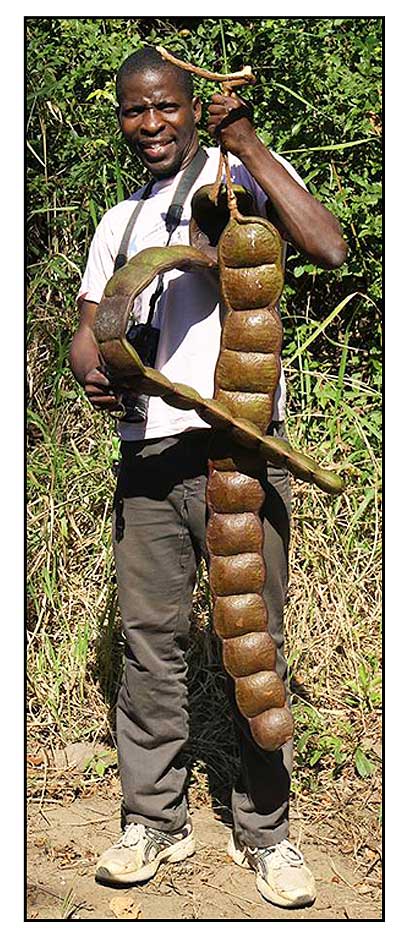
- Known for the largest seedpods of Fabaceae.
- Etymology: The specific epithet rheedei honors Hendrik Adriaan van Rheede tot Draakestein (1637-1691). (3)
- Its thick, lens-shaped seeds in exceptionally long pods can drift across oceans and wash up in distant shores.
 Botany Botany
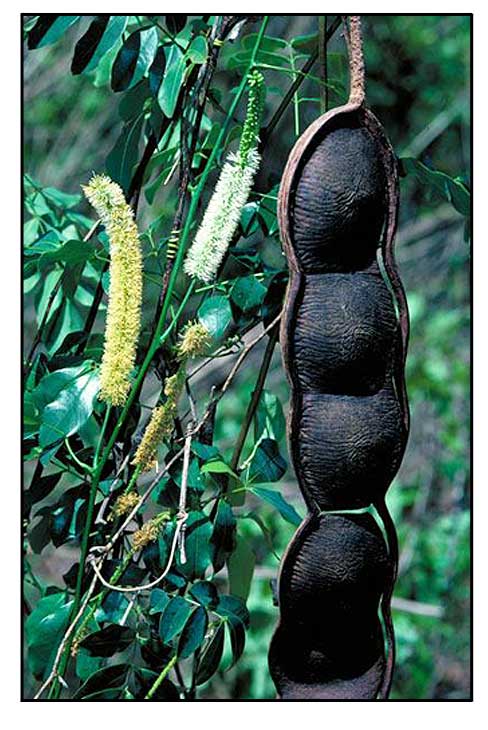
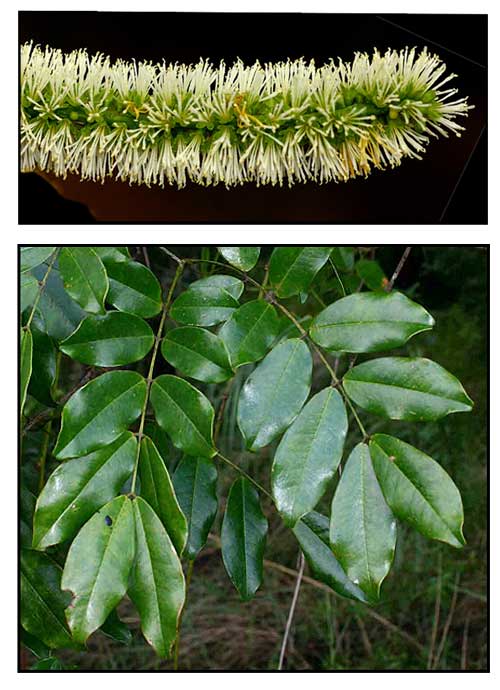
• Climbers, woody. Pinnae 2 pairs, 5-15 cm; leaflets 3 or 4(or 5) pairs per pinna, opposite, obovate to elliptic-lanceolate, unequally sided, 2.3-7 × 1.3-3.5 cm, papery, abaxially glaucous, base rounded to broadly cuneate, apex acuminate to obtuse, or emarginate. Spikes solitary or fasciculate, axillary, 12-25 cm. Flowers male or bisexual. Calyx green, cup-shaped, 0.8-1 mm. Petals white, narrowly elliptic to lanceolate, 2.8-3 mm. Stamens white, turning yellow, 5-6.5 mm. Ovary glabrous. Legume straight to slightly curved, to 2 m × 7-15 cm; segments 6.5-7.5 cm, epicarp and endocarp woody. Seeds brown, brilliant, suborbicular, flat, 3.5-4 × ca. 1 cm. (Flora of China)
• A vigorous, long-lived woody liana that ascends forest canopies along riverine, estuarine,
and coastal forest margins. Stems can become thick and rope-like; bark is brown. Leaves are alternate,
even-pinnate, typically with 2–4 pairs of obovate leaflets; rachis often ends in a bifid tendril facilitating
climbing. Inflorescences are elongated spikes bearing numerous small, cream-colored flowers, consistent with mimosoid floral architecture. Pale-cream to greenish-cream corollas. Fruit is a massively elongated, laterally flattened legume divided by strong constrictions into many single-seed segments. Pod large, maturing from coriaceous green to woody chestnut-brown or black. Seeds are large, thick-coated, lens-shaped, and buoyant, enabling long-distance sea dispersal and frequent beach castings far from the nearest mother plant. (Saxena and Brahmam, 1994; Nayak and Kumar, 2023)
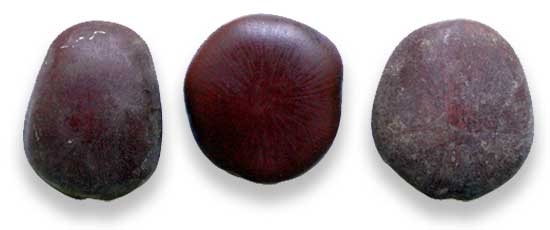 • The vine can grow as long as 120 m (390 ft). Seeds have a thick and durable seed coat, which allows them to survive long hours of immersion in seawater. Pods can be up to 6.5 feet (2 m) in length. • The vine can grow as long as 120 m (390 ft). Seeds have a thick and durable seed coat, which allows them to survive long hours of immersion in seawater. Pods can be up to 6.5 feet (2 m) in length.
• Closely related to Entada phaseoloides and mixed up with that species by Merrill. Distinct by 3 or 4 (or 5) pairs of leaflets per pinna, a woody tough endocarp and slightly less asymmetric terminal leaflets. (4)
Distribution
- Native to the Philippines. (1) (4)
- In primary and secondary forests, especially along rivers, behind mangroves and beach forests.
0-400m. (4)
- Also native to Andaman Is., Assam, Bangladesh, Bismarck Archipelago, Borneo, Cambodia, Cameroon, China South-Central, China Southeast, Christmas I., Comoros, DR Congo, East Himalaya, Equatorial Guinea, Ghana, Guinea, Guinea-Bissau, Gulf of Guinea Is., Hainan, India, Ivory Coast, Jawa, Kenya, KwaZulu-Natal, Laccadive Is., Laos, Lesser Sunda Is., Liberia, Madagascar, Malawi, Malaya, Maldives, Maluku, Marianas, Mozambique, Myanmar, Nansei-shoto, Nepal, New Guinea, Nicobar Is., Nigeria, Northern Territory, Queensland, Senegal, Sierra Leone, Solomon Is., Sri Lanka, Sudan-South Sudan, Sulawesi, Sumatera, Taiwan, Tanzania, Thailand, Tibet, Togo, Uganda, Vietnam, Zambia, Zimbabwe. (1)
 Constituents Constituents
- Study of 70% ethanol extract of seeds
isolated four phenolics: protocatechuic acid (1), protocatechuic acid methyl ester (2), 1,3,4-trihydroxybenzene glucoside (3), phaseoloidin (4); three thioamides: entadamide A (5), entadamide A-ß-d-glucopyranoside (6), entadamide C (7); and two saponins: rheedeioside A (8) and rheedeioside B (9). (see study below) (9)
- Study of seed kernels isolated Two new tryptophan derivatives, N-sulfonyl-L-tryptophan (tryptorheedei A) (1) and 3-(N-sulfonylindolyl)-D-lactic acid (tryptorheedei B) (2) together with the known 5-O-β-D-glucopyranosyl-2-hydroxyphenylacetic acid (3), 1-O-methylglucopyranoside, entadamide A, homogentisic acid and 3-O-β-D-glucopyranosyl-β-sitosterol. (see study below) (10)
- Bioactive compounds include
alkaloids, saponins, flavonoids, tannins, glycosides, and steroids, which are primarily concentrated in the seeds, bark, and leaves. (12)
- E. rheedii seeds are a rich source of protein (23.99%), starch (42.04%) and potassium (1670.15 ppm). HPTLC-UV analysis of seeds reveals galactose in considerable amount, 2.60%. (see study below)
(16)
Properties
- Seeds are buoyant and survive lengthy journeys via rivers and ocean currents, to eventually wash up on tropical beaches. (2)
- Studies have suggested antibacterial, antiviral, antiulcerogenic, cytotoxicity, antioxidant, membrane stabilizing, antifertility, antifungal, nutrient properties.
Parts used
Seeds, vine, leaves, stems.
 Uses Uses
Edibility
- The inner meat of the seed is edible, consumed directly. (3)
- Caution: Seeds reportedly poisonous when raw. Seeds traditionally thoroughly cooked and leached before eating. Alternatively, Seeds are roasted over fire and then soaked for 3 days before being eaten. (8)
Folkloric
- No reported folkloric medicinal use in the Philippines.
- In African traditional medicine, plant used for making topical ointment for treating jaundice, toothache, ulcers, and musculoskeletal problems. (3)
- In Bangladesh, pounded kernels of seeds mixed with oil applied as poultice to affected areas, to treat abdominal pain and colic. Seed paste applied to treat joint pains. Bark used for treatment of pains, itching, and fever. Decoction of dried vine materials used for treatment of rheumatic lumbar and leg pains, sprains, and contusions. Seed paste applied to glandular swellings in the axilla, joints, swollen hands and feet. Water added to pounded bark used as soap or as shampoo for dandruff. Seed poultice used for treatment of colic in children. Seeds used for treatment of fever. (5)
- In Africa and parts of Asia, decoction and poultices of seeds and other plant parts used for treatment of diarrhea, stomachache, and skin problems. (7)
Others
- Culture / Dream induction: The species is used in traditional African medicine and by shamans to induce vivid dreams, said to enable communication with the ancestral spirit world. The edible inner meat of the seed is chopped, mixed with other hebs like tobacco and smoked before sleep to induce desired dreams. (3) Leaves dried and smoked to induce vivid dreams. (8)
- Ornaments / Crafts: Seeds used for making ornaments and good luck charms. (3) In Africa, seeds are used as natural snuff boxes
- Poison: Bark reported used as fish poison. (8)
- Agroforestry: Plant plays a role in stabilizing coastal ecosystems by climbing over trees and enriching the soil through nitrogen fixation. (12)
Studies
• Antiulcerogenic / Antimicrobial / Seeds: Study of evaluated 70% ethanol extract of seeds and isolated compounds for antibacterial and antiviral activities using agar well diffusion and MTT assays respectively. Study isolated four phenolics, three thioamides and two saponins. Compounds 4, 5, and 8 showed significant (p<0.05) antiulcerogenic activity. Compounds 1 and 7 showed strong antibacterial activity. Compound 4 exhibited moderate (35% inhibition) antiviral activity. (see constituents above) (9)
• Effect on Cell Viability and HIV Infectivity / Seed Kernels: Study of seed kernels isolated Two new tryptophan derivatives, N-sulfonyl-L-tryptophan (tryptorheedei A) (1) and 3-(N-sulfonylindolyl)-D-lactic acid (tryptorheedei B) (2) together with the known compounds. Compounds 1 and 2 showed early effects in HIV infection, likely by inhibition of enzyme indolamine 2,3-dioxygenase IDO) and prevented tryptophan depletion. Inhibition of IDO acutely in HIV infection inhibits viral replication, but chronic activation of IDO leads to immune impairment in AIDS. IDO is also gatekeeper enzyme for kynurenine metabolism,a pathway involved in serotonin and melatonin biosynthesis and regulation of glutamate and dopamine levels in the brain. IDO inhibition may be related to the medicinal and neuropsychiatric effects of E. rheedei. (10)
• Cytotoxicity / Antioxidant / Membrane Stabilizing / Bark, Leaf, Seed: Study evaluated methanolic extracts of bark, leaf, and seed of E. rheedii and partitionates for cytotoxic, membrane stabilizing, antimicrobial, and thrombolytic activities. In brine shrimp lethality bioassay, a chloroform seed extract showed significant cytotoxicity (LC50=1.95 µg/mL, LC90 =3x10⁻⁴µg/ml) compared to vincristine at LC50=0.45 and LC90=9x10⁻⁶). Antioxidant activity by DPPH assay of EA partitionate of bark showed highest free radical scavenging activity with IC50 of 33.68 µg/ml compared to standard ascorbic acid (IC50 4.05 µg/ml). Aqueous and EA soluble fractions of bark showed significant membrane stabilizing activities with 94.94%of aqueous and EA fractions of bark in hypotonic solution-induced hemolysis and 97.39% in heat-induced condition, respectively. No significant antimicrobial or thrombolytic activities were observed for any plant extractive. (11)
• Antifertility Potential/ / Seed: Study evaluated the antifertility potential of methanol extract of E. rheedei seed kernels in female Wistar rats in doses of 200 and 400 mg/kg by oral route. Treatment resulted in statistical increase in resorption index (p<0.001) suggesting a failure of embryonic development. Anti-implantation and abortifacient effects were seen with both doses. Results showed potential and reversible antifertility effect in female Wistar rats. (13)
• Antidiabetic / α-Amylase Inhibitory / Anti-Inflammatory/ Leaves and Stems: Study evaluated leaf and stem ethanolic extracts of E. rheedii for anti-inflammatory, antidiabetic, and radical scavenging potentials. Study showed high radical scavenging by DPPH, ABTS, NO, and superoxide assays in a dose-dependent manner. Both leaves and stems showed appreciable α-amylase inhibitory activity when compared with standard acarbose and strong anti-inflammatory effect compared to standard diclofenac sodium. (14)
• Antifungal / Seeds: Study evaluated the antifungal properties of E. rheedei and in silico method to study bioactive phytoconstituents. An aqueous extract of seeds exhibited significant antifungal inhibitory activities against Aspergillus flavus and A. fumigatus. GC-MS analysis revealed 13 bioactive compounds that could be potent antifungal inhibitors. In silico molecular docking analysis revealed benzoic acid, 2,4-bis(trimethylsilyloxy)-trimethylsilyl ester as the active antifungal constituents of the aqueous extract with docking score of -8.0570 and -9.4564 kcal/mol against A. flavus and A.. fumigatus respectively. (15)
• Nutritional Potential of Underutilized Legume / Seeds: Study reports on the nutritional characterization of E. rheedii seeds and its potential as an alternative source of dietary nutrition, fortified with medicinal value. The seeds are a rich source of protein, starch, and potassium; additionally, low fat, with proximates comparable with commonly consumed legumes like cowpea, green gram, among others. Standardization can bring the underutilized, low-cost legume for daily dietary intake and a potential source for protein-energy-malnutrition. (see constituents above) (16)
Availability
- Wild-crafted.
- Seeds in the cybermarket. |