|
 Gen info Gen info
- Intsia is a genus of flowering plants in the family Fabaceae. It includes 2 species: Intsia bijuga and I. palembanica.
- Intsia bijuga is a species of tree native to coastal areas from east Africa, through India and Southeast Asia to Australia and the western Pacific.
(7)
-
Intsia bijga, ifit, is the official tree of the United States Territory of Guam. (Named the territorial tree of Guam in 1969)
- Taxonomy: The species was first described as Macrolobium bijugum by English botanist Henry Thomas Colebrooke in 1819, and transferred to the genus Intsia by German botanist Carl Ernst Otto Kuntze in 1891. (8)
- Etymology: The genus name intsia derivation is uncertain, but it has been suggested it derives from the Malayalam name for Acacia (Acacia intsia). The specific epithet bijuga, derives from Latin words bi meaning "two", and jugus meaning "paired", referring to the two pairs of leaflets in the compound leaf. (8)
Botany
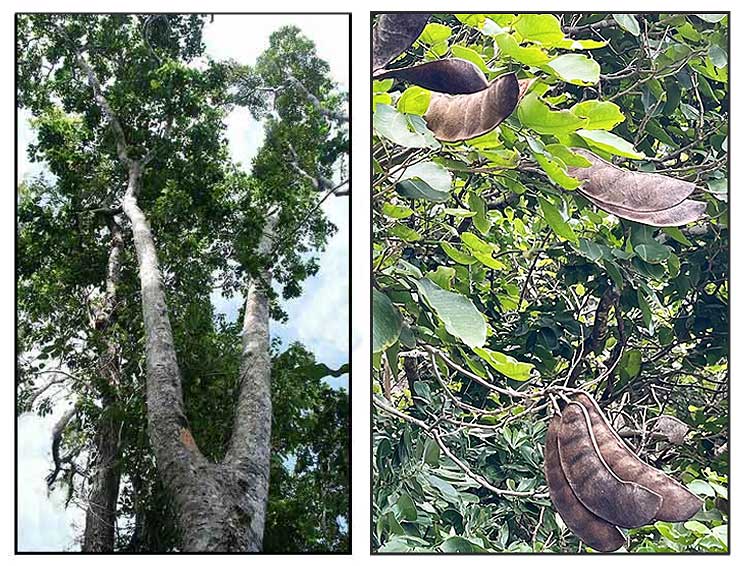
• Ipil is a medium-sized, slow growing tree reaching a
height of 20 to 45 meters and a trunk of 0.5 to 5 meters. Mature trees have steep rounded buttresses.
Bark
is 5 to 8 millimeters thick, gray in color with an orange tinge. The inner bark is light
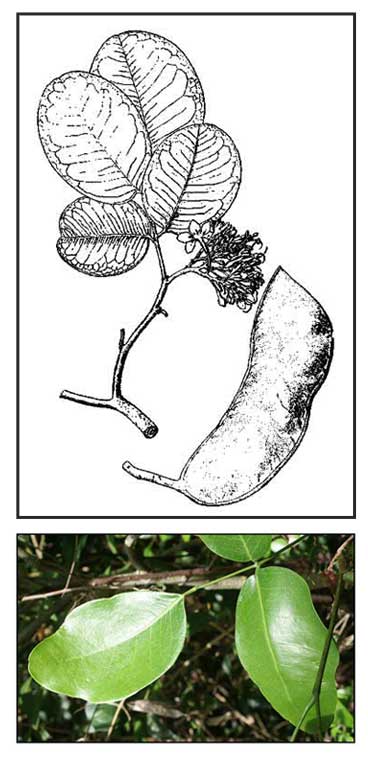
brown and mottled with brown specks. Leaves are alternate and simply
compound with usually two pairs of leaflets, 8 to 12 centimeters long and 5 to
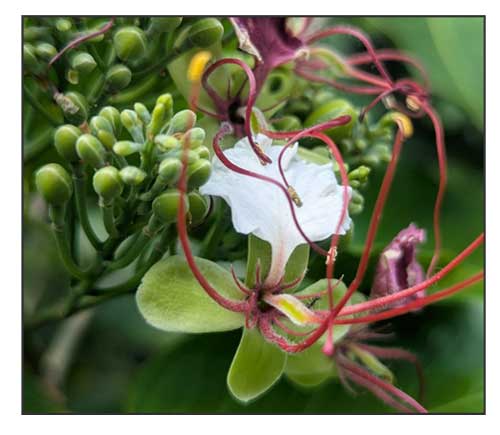
8.5 centimeters wide. Flowers are fragrant, white or reddish, borne in panicles
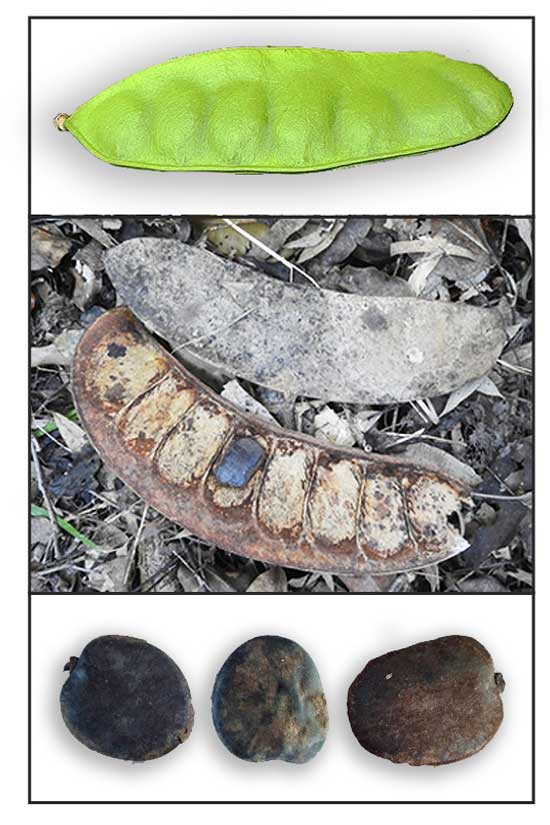
6 to 10 centimeters long. Pods are oblong or pear-shaped, woody, tardily dehiscent, 10 to 25 centimeters long and 4 to 6 centimeters wide, with
3 to 9 orbicular seeds.
• Growth form: A tree that can grow up to 50 m tall, with up to a 250 cm diameter at breast height for the trunk, and can have buttress roots up to 4 m tall and 2 m wide. Foliage: Spirally arranged, stalked leaves have 1–3 pairs of thinly leathery leaflets that are oppositely arranged. Each leaflet is broadly oval, egg-shaped or drop-shaped, and 2.5–18 by 1.5–12 cm. Flowers: Flowers are in flowering shoots (inflorescences) that are up to 17 cm long. Its flowers are bisexual. Its white or pink flower petals are 6–30 by 10–35 mm. Fruit: Fruits are woody pods that have one cavity and one row of seeds, that are oblong, slightly flat, are brown or black when ripe, and 8.5–28 by 4–7.5 cm. Its seeds are hard-coated, 2–3.5 cm in diameter, and 0.8 cm thick. (Flora & Fauna Web)
 Distribution Distribution
- Native to the Philippines. (7)
-
Along the seashore,
and in some localities, in inland forests, from the Babuyan Islands and northern Luzon to Mindanao and Palawan.
- Also native to Andaman Is., Bangladesh, Bismarck Archipelago, Borneo, Cambodia, Caroline Is., Chagos Archipelago, Fiji, India, Jawa, Madagascar, Malaya, Maluku, Marianas, Marshall Is., Mauritius, Myanmar, New Caledonia, New Guinea, Nicobar Is., Northern Territory, Queensland, Samoa, Santa Cruz Is., Seychelles, Solomon Is., Sri Lanka, Sulawesi, Sumatera, Taiwan, Tanzania, Thailand, Tonga, Vanuatu, Vietnam. (7)
- IUCN listed as Vulnerable. (1998) (9)
Constituents
- Bark yields tannin.
- Wood yields a khaki-colored dye.
- Phytochemical screening of leaves yielded anthrones, flavonoids, glycosidic flavonoids, phenolic compounds, steroids, tannins, triterpenes, anthraquinones and coumarins.
- Study has shown robinetin as the main polyphenol of the heartwood of I. bijuga, together with 3,5,4'-tri and 3,5,3',4'-tetrahydroxystilbenes, dihydromyricetin myricetin, and narigenin (Hills and Yazaki, 1973). (11)
Properties
- Studies have suggested antitrypanosomal, cytotoxic, antiulcer, xanthine oxidase inhibitory, radical scavenging, tyrosinase inhibitor, sun protective, antiaging, anti-coronavirus potential properties.
Parts
utilized
Leaves, bark, fruit.
 Uses Uses
Edibility
• Seeds can be eaten after careful preparation: soak in salt water for 3-4 days, and then boiled.
• Fruits are edible.
Folkloric
• Bark, which
contains tannin, used for diarrhea.
• Fruit used as laxative.
• Bark used for urinary conditions.
• In Fiji, decoction
of bark used for rheumatism, chills, diarrhea, muscle rigidity and rheumatoid
arthritis; mixed with the extracts of other plants, used for broken
bones. Juice of stems used for asthma.
• Decoction of leaves used when body is possessed by spirits.
• Mixed with other plant extracts, used for toothache and sore tongue. Also
used for scabies and headaches.
• Bark infusion given to women after delivery.
• In the Solomon Islands,
used to treat very dark urine caused by sorcery; also used for rheumatism,
diarrhea and dysentery.
• In Samoa, bark
used for treating enlarged lymph nodes.
• In Vanuatu, the
inner bark of Intsia bijuga, squeezed in coconut water, is taken as
a remedy for asthma. The leaves or inner bark are squeezed in salt water
and the solution is ingested for diabetes. (2)
• In Madagascar, women from Agnalazaha littoral forest use leaves for cough and placental appositioning. (12)
Others
• Ritual / Culture: In Fiji, once considered a sacred tree. The traditional drinking bowl for yagona was made from the wood of the tree. Also, leaf decoction drank to rid the body of evil spirits. (•) Too, the Tivia clan of Suburam village on the north coast of Papua New Guinea believes the timber has spiritual powers. (8)
• Wood: Known for its hard and durable wood; used for
timber, furniture making or carving craftwood. Durable against dry-wood termite, Cryptotermes cynocephalus the the subterranean termite Coptotermes curvignathus. (10)
• Dye: Wood yields a khaki colored dye. Fresh sap makes indelible stains on paper or cloth.
• Repellent: An insect repellent is made from the seeds.
• Poison: Seed oil repels stored products, tenebrionid pest.
- Agroforestry: Coastal protection, windbreak, coastal soil stabilization, living fence, and nitrogen fixing.
(15)
Studies
• Anti-trypanosomal: The
ethanol extract showed good and specific activity against Trypanosoma
cruzi. However, it also exhibited high cytotoxicity which might explain
its observed activity. Study has also suggested immuno-modulatory activity.
• Phytochemicals / Radical Scavenging Activity: In a study of four Philippine medicinal plants, phytochemical screening of Intsia bijuga revealed anthrones, flavonoids, glycosidic flavonoids, phenolic compounds, steroids, tannins and triterpenes. The tannins may justify its folkloric use for dysentery (leaves). I. bijuga showed lowest radical scavenging activity, with EC50 of 1846 µg/ml. (3)
• Cytotoxicity: On brine shrimp lethality assay, I. bijuga leaves had an LC50 value of 86.5 µg/ml. All crude methanol extracts of the four Philippine medicinal plants tested had 100% mortality to brine shrimp at 1000 µg/mL. (3)
• Anti-Ulcer / Leaves: Study evaluated methanol extracts of leaves of nine plants, including Intsia bijuga, for anti-ulcer activity using HCl-ethanol as ulcerogen. All extracts showed inhibitory activity with I. bijuga among those that showed more than 50% inhibition. (5)
• Xanthine Oxidase Inhibitory Activity: Xanthine oxidase inhibitors is a urate lowering agent, blocking the synthesis of uric acid, and used in the treatment of hyperuricemia and gout. Study evaluated the xanthine oxidase inhibitory activity of methanol leaf extracts of 10 plants, including Intsia bijuga. All the extracts inhibited the action of xanthine oxidase. (6)
• Tyrosinase Inhibitory / Antiaging / Antioxidant / Sun Protective / Heartwood: Study evaluated solvent extracts and phytosome formulation of heartwood extract as ingredient for topical antiaging cosmetics. Results showed 50% ethanol possessed good antioxidant and antityrosinase activity, but was lower in SPF (sun protection factor) value. Phytochemical profiling revealed robidanol and robinetin as main constituents in the extracts. Phytosome F3 exhibited high antioxidant, antityrosinase, and SPF values compared to the other 50% ethanol phytosome extracts. Results suggest potential for extracts and phytosomes for development as antiaging active ingredient in topical use cosmetics. (14)
• Anti-Coronavirus Activity / : Study evaluated I. bijuga for phytochemicals with anti-coronavirus activity through insilico screening. Results showed I. bijuga contained six compounds with anti-corona-virus activity: ampelopsin, naringenin, myricetin, robinetin, piceatannol, and resveratrol. Inhibitory activity was shown in the interaction of myricetin with 3CLpro and ACE2, as well as robinetin and PLpro and ACE2. (16)
Availability
Wildcrafted.
Ornamental cultivation.
|