
HOME      •      SEARCH      •      EMAIL    •     ABOUT


Family Malvaceae
Nodding malvaviscus
Malvaviscus penduliflorus Moc. & Sessé ex DC.
SLEEPING HIBISCUS

Scientific names Common names
Malvaviscus arboreus var. longifolius Schery Cardinals's hat (Engl.)
M. arboreus var. penduliflorus (Moc. & Sessé ex DC.) Schery Firecracker hibiscus (Engl.)
M. arboreus subsp. penduliflorus (Moc. & Sessé ex DC.) Hadac Ladies' teardrop (Engl.)
Malvaviscus longifolius Garcke Mazapan (Engl.)
Malvaviscus penduliflorus Moc. & Sessé ex DC. Nodding malvaviscus
  Pendulous sleeping hibiscus (Engl.)
  Sleeping hibiscus (Engl.)
  Sleepy mallow (Engl.)
  Turk's cap mallow (Engl.)
  Turk's turban (Engl.)
  Wax mallow (Engl.)
Malvaviscu penduliflorus Moc.& Sessé ex DC is an accepted species. KEW: Plants of the World Online

Other vernacular names
CUBA: Pasiflora.
INDIA: Dhadoonj, Laal phool; Jubakusum (Manipur).
PALAUAN: Busonge.

Gen info
- Malvaviscus penduliflorus is a flowering plant in the family Malvaceae,, found in many tropical places including the United States, South American, Asia, and Australia.
- Etymoloogy: The genus name Malvaviscus derices from Latin words malva, meaning "mallow', and viscus, meaning "sticky", referring to the mucilaginous sap produced by some members of the genus. (4) The specific epithet penduliflorus means "hanging flower". Turk's cap refers to the resemblance of the flower to the hat worn by Turkish people. The adjectival words "nodding, drooping, and pendulous" refer to the flower's habit: upward before blooming, but drooping once they open.

Botany
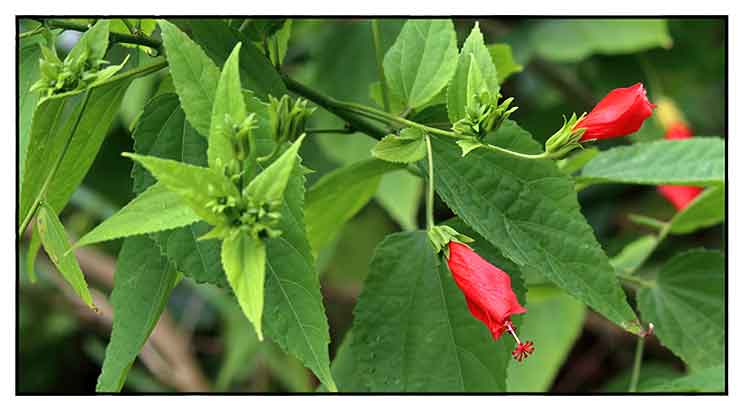
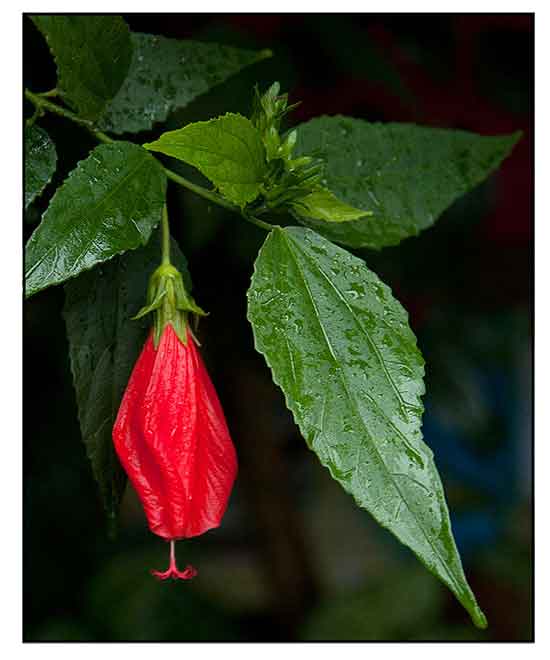
Malvaviscus penduliflorus is a perennial shrub that can reach up to 3–4 m (9.8–13.1 ft) tall.[3][6] It produces red hanging tubular flowers with stamens that stick out. It has pointed, ovular leaves and hairy stems.[6] Like other members the Malvaviscus genus, M. penduliflorus produces sap and small red fruits.

• M. penduliflorus  is often confused with Malvaviscus arboreus var. arboreus, but easily differentiated by its spectacular, pendulous flowers.

• Flowers are generally scarlet, but variations of pink, orange and white exist.

• Erect shrubs, ca 2-3 m high. Branchlets are hairy (hairs recurved) to hairless. Stipules are threadlike, about 4 mm, falling off. Leaf-stalks are 1-2 cm, hairy. Leaves 5-20 * 3-12 cm ovate to elliptic or lanceolate, usually rounded at base, long acuminate at apex, crenate-serrate; petioles 1-10cm long; stipules 3-5 mm long, linear. Flowers are red, solitary, axillary, pendulous, tubular, opening slightly at the top; pedicels 2-6 cm long. Epicalyx segments 6 or more, 1-1.5 cm long, oblong, somewhat spathulate. Calyx slightly longer than epicalyx, fused to the middle above; lobes lanceolate. Corolla 5-7 cm long, pendulous. Staminal column exserted. Carpels 5; style branches 10, basally connate; stigmas capitate. Fruits a fleshy schizocarp. (6)

Distribution
- Naturalized. (2)
- In Bohol, Leyte, Negros, Panay; Luzon: Cavite, Laguna, Mountain Province, NCR, Rizal, Sorsogon; Mindanao: Davao del Sur. (2)
- Native to Colombia, Costa Rica, Ecuador, El Salvador, Guatemala, Honduras, Mexico Central, Mexico Gulf, Mexico Northeast, Mexico Southeast, Mexico Southwest, Nicaragua, Panamá, Peru, Texas, Venezuela. (1)

Constituents
- GC-MS analysis of hexanic extract of dried flowers yielded 2.2% of a yellow pale solid extract, composed mainly of hydrocarbons (C9-C32, including squalene); fatty acids (C9:0-C30:0); sterols (β-sitosterol, 24-ethylidene-3-β-trimethylsiloxy-5-cholesterol, stigmasterol, campesterol, γ-sitosterol, cholesterol, 24-oxo-cholesterol, Δ-4-sitosterol-3-one, 24-ethylidene-3-β-trimetilsiloxy-5-xi-colest-7-ene and fatty alcohols (C26OH-C32OH). (5)
- Phytochemical screening of aqueous extracts of floowers and leaves yielded saponins, sugars, alkaloids, and flavonoids. (7)
- Fatty acid profile of flowers are dominated by palmitic and stearic acids.

Properties
- Flowers attract pollinators such as hummingbirds and butterflies.
- Studies have suggested antibacterial properties.


Parts used
Flowers, leaves.

Uses

Edibility
- Flowers and fruits are edible. Fruit used for making jelly or syrup. Both fruit and flowers are used for making herbal teas.
- Flowers are reportedly eaten off the stem; sweet, even when unopened.
-
Flowers add color and hisbiscus flavor to salads.
Folkloric
- In Benguet Province, crushed flowers and leaves applied as poultice on boils and athlete's foot. (11)
- Used in traditional medicine for treatment of fever, rheumatism, and skin conditions.
- In Cuba, flowers in brew form used as sedative. (7)
- In Manipur, India, herbalists of the Muslim community prescribe decoction of leaves (250 gm of leaves boiled in 1000 cc of water) to be drunk twice daily for white discharge of women. (8)
- Decoction of Dhadoonj flowers used for treatment of bronchitis, fever, sore throat, inflammation of the digestive tract. Leaves and flowers used to soothe irritated, itchy skin. Paste of flowers and leaves applied to promote hair growth. Also used as cardiotonic and diuretic to lower blood pressure. (4)
Others

- Ritual: Dhadoonj flowers are indispensable offering to the Hindu deity Maan Durga. According to local people of Mandi, Himachal Pradesh, India, one flower offered to the Goddess Durga is equal to one goat sacrifice. (6)
- Landscaping: Grown as ornamental or as hedge plant.
- Fodder: Flowers and fruits used as insect and animal feed. (4)

Studies
Antibacterial:
In-vitro study evaluated methanolic extracts of Malvaviscus pendulifloruus (Malvavisco) and Desmodium molliculum (Manayupa) against strains of Streptococcus sanguinis (ATCC®10556) and Porphyromonas gingivalis (ATCC®33277TM). Malavisco extract showed greater antibacterial effect against P. gingivalis strains with inhibition halos of 17.83 mm and  15.25 mm against S. sanguinis. (9)

Availability
- Wild-crafted.
- Flowers in the cybermarket.


September 2025

                                                 PHOTOS / ILLUSTRATIONS
IMAGE SOURCE: Malvaviscus penduliforus : Flower and leaves / © BT Wwursten : Flora of Zimbabwe / Non commercial use / Image modified / Click on image or link to go to source page / FloraOfZimbabwe
OTHER IMAGE SOURCE: Sleeping hibiscus / Malvaviscus penduliforus / © Lauren McLaurin / CC BY 4.0 / Some rights reserved / Click on image or link to go to source page / iNaturalist

Additional Sources and Suggested Readings
(1)
/ KEW: Plants of the World Online
(2)
Malvaceae: Malvaviscus penduliflorus / Co's Digital Flora of the Philippines
(3)
Malvaviscus penduliflorus / Wikipedia
(4)
Malvaviscus / Wikipedia
(5)
Determination by GC-MS of the Hexane Extract Components from Malvaviscus penduliflorus Flowers Growing in Cuba / David Marrero Delange, Carmen Morales Rico, Eduardo A Rodriguez-Leyes et al / Analytical Chemistry Letters, 2012 / DOI: 10.1080/22297928.2000.10648266
(6)
Malvaviscus penduliflorus Mocino & Sesse ex DC.-Dhadoonj, Laal phool / Himalayan Wild Food Plants, 2023
(7)
Phytochemical screening of Malvaviscus penduliflorus growing in Cuba / Roxanna de la C Sierra Perez, Victor L Gonzalez Canavaciolo et al / Rev Cubana Plant Med., 2010; 15(4) / ISSN: 1028-4799
(8)
Record of Traditional Medicinal Practice of the Herbalists of Muslim Community in Manipur
/ Ahmed Mohd Mustaque, SK Borthakur / NSB: Notulae Scientia Biologicae, 2013; 5(4): pp 426-430 / pISSN: 2067-3205
(9)
Evaluación in vitro del efecto antibacteriano del extracto metanólico de malvaviscus penduliflorus (malvavisco) y Desmodium molliculum (manayupa) sobre cepas de Streptococcus sanguinis (ATCC® 10556) y Porphyromonas gingivalis (ATCC® 33277 TM) / Repositorio Academico UPC
(10)
Malvaviscus penduliiflorus / Flower Database
(11)
Ethnomedicinal Plants in Bayabas, Sablan, Benguet Province, Luzon, Philippines / Teodora D Balangcod, Kryssa D Balangcod / eJBio: Electronic Journal of Biology, 2015; 11(3): pp 63-73

DOI: It is not uncommon for links on studies/sources to change. Copying and pasting the information on the search window or using the DOI (if available) will often redirect to the new link page. (Citing and Using a (DOI) Digital Object Identifier)

                                                            List of Understudied Philippine Medicinal Plants
                                          New plant names needed
The compilation now numbers over 1,750 medicinal plants. While I believe there are hundreds more that can be added to the collection, they are becoming more difficult to find. If you have a plant to suggest for inclusion, native or introduced, please email the info: scientific name (most helpful), local plant name (if known), any known folkloric medicinal use, and, if possible, a photo. Your help will be greatly appreciated.

HOME      •      SEARCH      •      EMAIL    •     ABOUT